(Words by Elizabeth, sentiments by both)
Watch or listen to the whole article here
Watch Anna and Elizabeth’s more personal apology video here
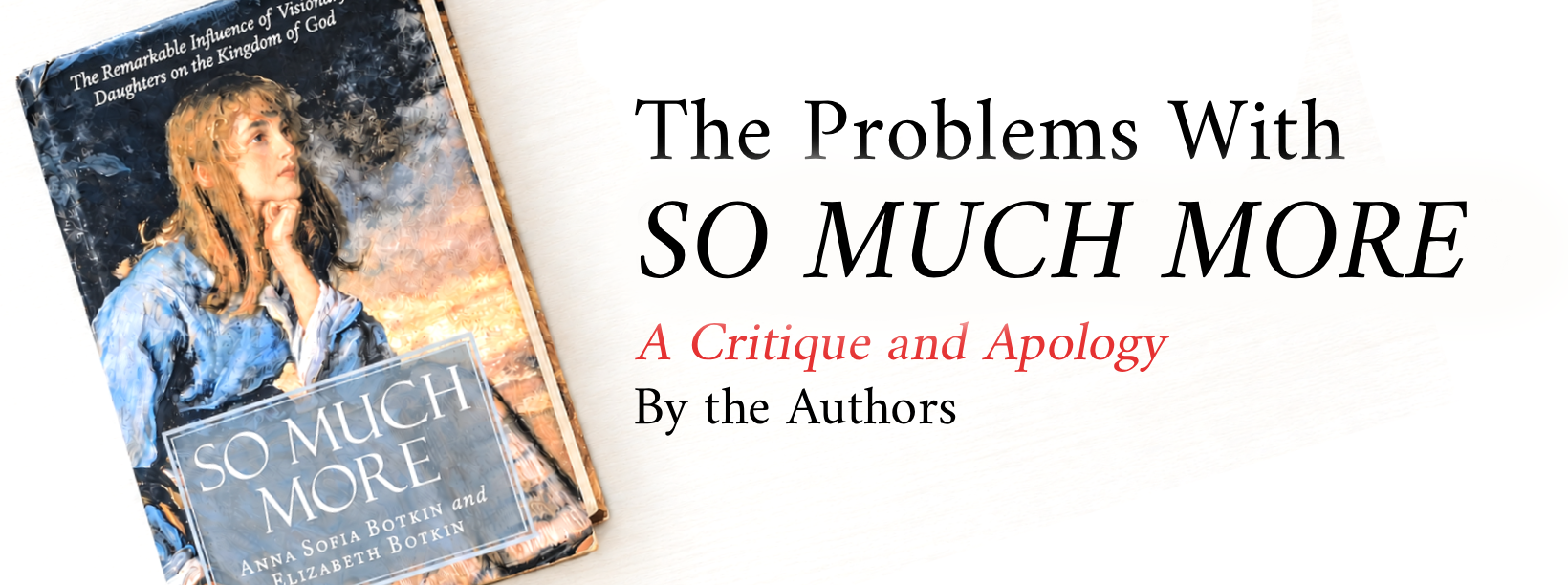
Twenty years ago, we published a book called So Much More: The Remarkable Influence of Visionary Daughters on the Kingdom of God. Whether by some impressive ad campaign, or just by the cresting wave of interest in the topic at that time, this 352-page hardback by two unknown teenagers with no theological training or life experience became the manifesto of the burgeoning “Stay at Home Daughter” movement. And it shaped a lot of lives. You may never have heard of it, but it carried a disproportionate amount of weight, and directed major life decisions for thousands of young women. And it’s still doing so.
And though some say So Much More was helpful to them, there are many, many others who have been harmed by how its teaching shaped their decisions or options regarding family, education, work, ministry, spiritual growth, where to live, and how to spend their single years. And to be perfectly honest, that also would include ourselves – the authors.
We were 17 and 19 when we finished writing So Much More (15 and 17 when we started writing), and we’ve spent the twenty years since then watching the rubber of So Much More‘s ideas meet the road of reality in our own lives and many others’. Twenty more years of growing in our actual relationships with the Lord and His word and realizing how off-base our teenaged handling of Scripture really was. And twenty years of seeing the fruit of the stay-at-home-daughter movement in general and watching other people pick up the bill from our mishandling of Scripture.
But these aren’t ultimately what made us realize the problems with So Much More‘s theology. It wasn’t that we got older or living at home got harder. It wasn’t that we saw friends deconstructing and wanted to do the same. It wasn’t even that we saw hundreds of stay-at-home daughters pursuing the “ideal” into extremely non-ideal situations.
What made us realize So Much More’s theology was wrong was simple: We re-read it.
We re-read it, almost two decades later, with better hermeneutics and a better understanding of church history and historic theology, and realized our entire case was exegetically hollow. And that the life we had given up so much to live, and worst of all had called others to live, was built on a theological house of cards.
What Was the Message of So Much More?
Well, across 352 pages, we said quite a bit, but the book’s main message was this:
Daughters living at home until marriage, serving their dads and families (instead of getting jobs, going to college, or doing missions work), was the “biblical model,” “the ideal,” “God’s best,” and the only good option for a serious Christian girl. Though we didn’t outright say it was commanded (exactly), in painting it as “God’s best” and not acknowledging any alternatives except bad ones, we bound readers’ consciences to something that was not a command (and truly a bad situation for many girls).
The central thesis of this article is that So Much More commanded things God didn’t command, forbade things God didn’t forbid, cut off lawful paths of fruitfulness, and unbiblically shrunk a single woman’s options. The tragic irony of So Much More is that our whole goal was to encourage readers to live according to Scripture, not culture. We believed we had discovered an even more biblical approach to single womanhood than the evangelical mainstream. But instead we painted an unbiblical picture: We added to Scripture, we mistaught it, and we presented as “God’s best” a package that was truly “so much less” than God calls His daughters to.
Yes, many young women chose to keep living, working, and ministering with family until marriage and had a wonderful experience! Any individual element of the lifestyle we taught could be a good and beautiful thing – family ministry or business, domesticity, living a passionate, selfless, sold-out life of service to the Lord, even being willing to follow Scripture into very counter-cultural paths. But additions to Scripture are contortions – contortions of God’s ethics, of God’s desire for our lives, and of God’s very character. The Pharisees, at least ostensibly, were trying to promote greater holiness when they fenced and added to the law in their various ways, but Jesus did not admire their “set-apartness” or”radical-ness” – He called it “loading people with burdens hard to bear” (Luke 11:46), “teaching as doctrines the commandments of men.” (Matt 15:9).
Of course, we had 352 pages’ worth of reasons why we believed this was the model Scripture taught, and we’ll address the biggest ones presently.
What’s more, we were largely just trying to take a lot of commonly-taught concepts of “biblical womanhood” (such as women having an exclusively domestic focus, or being dependent on male authority during every season of their lives) to their logical conclusion. As fringe or niche as our final package was, many of the pieces that went into the pie were well-respected and broadly taught in parts of conservative evangelicalism.
The young women still living this lifestyle as if it’s commanded, and the parents and pastors still promoting it, often have serious, good-faith reasons why they believe Scripture is on their side. These arguments deserve a compassionate but rigorous re-examination. Thus we’re writing this both to those who have long left this way of thinking, and those who still hold it tightly, as well as those still sorting it all out.
If you loved So Much More, you may be concerned that we’ve deconstructed, gone squishy on Scripture, turned egalitarian, or become angry feminists. The truth is that we’ve become more consistent confessional Christians who hold fast to the God-ordained differences between men and women, the beauty of the biblical family, the applicability of Scripture to all of life, and lots of other things that might make deconstructionists disappointed with where this paper is going.
The backbone of our theological development is still that God’s word is infallible and the only standard for ethics. But we also have learned what we didn’t know as teens: that there is an actual science to interpreting and applying it, which many conservative homeschooling speakers, books, and subcultures in the ’80’s-00’s sidestepped. When we wrote So Much More, we knew nothing about the hard disciplines of hermeneutics, exegesis, historic Christianity, or theology in general. What’s more — and what’s very obvious on a re-read — is that at the time of writing, we were both very new believers who, while genuinely zealous for Christ, were very immature in our walks with the Lord, and our immaturity in the faith had big implications for how we presented the Christian walk (which we’ll show in more detail momentarily).
If you’re concerned that we now think following culture instead of Scripture would have been better all along or that we’re going to handwave away any of God’s actual biblical requirements for women, please keep reading to see why many of So Much More‘s positions on women’s roles went against the Bible’s teaching on women, and to see if you find our Scriptural study and conclusions now as compelling as you found the ones we made as exegetically-untrained teenagers.
If you believe God genuinely used So Much More for good in your life, we are not here to dismiss your experience, or His ability to use even very flawed means!
But if you were one of the many who were hurt by So Much More — if it shaped decisions you now regret about education, work, relationships, ministry, where you lived, how you spent your twenties or thirties — we are deeply sorry.
If it contributed to spiritual harm, abuse you couldn’t escape, or influenced those in authority over you to take away opportunities you can never recover, we grieve with you.
If it bound your conscience to do things God doesn’t require, or feel guilt over things God would have allowed (or called) you to do, we’re sorry for binding these false burdens, and the false guilt this brought into your life.
We’re sorry for how we harshly, gracelessly, and pridefully caricatured and straw-manned those who made different life choices or came to different positions, making our view the only possible “right” view.
We’re sorry for how we misrepresented God’s word and (most likely) His will for your life. We confidently insisted that God required of you things He hadn’t, and forbade things He hadn’t. This was a sin against both God and you.
And we’re sorry for how we misrepresented God’s character and His heart toward you. By depicting God as only giving His daughters a few options – as opposed to the abundance that He demonstrated from the very first in the garden, urging Adam and Eve to eat freely of every tree but one – we depicted Him as stingy and controlling, rather than as a generous, abundant God Who treats us like sons and daughters instead of slaves. And by dishing out one-size-fits-all prescriptions or solutions for hard situations, we presented God as narrow-minded, simple, and ignorant of the kind of complex or awful situations that many of His daughters were actually in, instead of a God Whose word always provided the vulnerable with a way out of bad situations.
We ask your forgiveness for all this and any other harm the book caused you.
Besides confessing our errors, however, there is another reason we’re writing this paper, and it’s because we were not the only ones who taught these things. These ideas are still being taught, even enforced – by parents, pastors, and young women’s individual consciences, keeping these young women from being able to obey the full counsel of God, and from full Christian freedom to follow the Holy Spirit’s individual leading and calling into lawful areas. Many fervent-hearted, God-loving young women do not have the freedom to obey the full counsel of God, many consciences are still bound to not do much of what God would allow (and possibly call) them to do; and many parents and pastors are preventing young women in their 20’s and 30’s from having full access to the options God built into the Christian life. We can’t break every chain, but we’ll do our best to break the ones we forged.
Let’s walk through So Much More’s biggest problems.
What Were the Problems?
Problem # 1. We said that daughters living at home until marriage, serving their dads and families, was the “biblical model,” “the ideal,” and the only good option for a serious Christian girl – even though it is not required by God, minimizes emphases that God does have for believers, and frequently put girls in very non-ideal situations.
It’s worth saying again that there are plenty of valid reasons a young woman might decide living with her parents is the best place for her at her particular season of life. Our point here is not to say there’s something wrong with this choice, for those who have actually made this choice.
The problem was the way we spiritually strong-armed young women through scare tactics, guilt-manipulation, bad logic, and a contorted use of Scripture to think it would be morally inferior to make any other choice — to see living at home until marriage as all-but commanded by God when it is not.
Here’s an example of how we did this, in Chapter 12 (note that the book was written in Q&A format):
“If I’m supposed to be an active part of my family, then does that mean I should live at home until I’m married?
“In historic biblical circumstances, a girl lived at home under her father’s roof until she was married.
“But that was then and this is now, right?
“What women have now is neither progress nor improvement. Western women are much worse off than they have been for a long time. Our plans and desires should not be based on what we want or what the culture says we need. We should seek God’s best. We should seek and welcome God’s protection. We should also seek and welcome our father’s protection until we have our husband’s protection. It may not be unlawful to live in an environment that doesn’t offer protection, but is it profitable?… If a daughter is wise enough to understand her need to be fully under the authority and protection of her father, it’s so logical that she would seek those all the way, instead of giving them a token nod.
“Throughout the whole Bible we see examples of young women who lived at home under their fathers’ protection until they were given in marriage. One example of a daughter who left home to seek friends outside the covenant community is Dinah, who is interestingly called “the daughter of Leah” instead of the daughter of Jacob. Look her up in Genesis 34 and see what a mess she made for herself, her family, and the entire neighboring kingdom.”
That’s a lot of problems for one page. (More on the Dinah one in a minute.)
And all of them add up to ostensibly answering the question “Is staying at home until marriage commanded?’ by saying “No, but yes.”
Obviously, on this page we were trying to unpack why we thought it was somewhat implicitly required by God, or at least His preference, so let’s walk through some of the reasons why that’s not true.
Why Living at Home Until Marriage is Not Required, Reason 1: God doesn’t actually require young women to live under their father’s authority until marriage, or give fathers unlimited, indefinite authority to forbid their daughters moving out.
One of the strongest arguments for daughters needing to live at home until marriage is the idea that their fathers have the authority to require it – that a father has indefinite authority to call all shots in his daughter’s life, including how long he gets to call all the shots.
In So Much More we explained the father’s authority over his daughter as lasting until he transferred it to a husband. (Thus “daughters should live at home until marriage” was often enforced with the weight of a Scriptural command, by parents, church elders, and girls’ own consciences. In many cases, a grown woman who wanted to leave her father’s home had to provide proof of something as serious as a wife’s grounds for leaving her husband.)
Here are two reasons why this is not biblical:
First, the idea that God prefers women to always be under a male family authority, and prefers unbroken authority from father to husband, is not in the Bible.
On SMM page 34, we said: “…God’s design gives each woman, whether married or unmarried, a protective head to which she must submit. As we have said before, a woman’s life will always be tied into a man’s life, whether she is married or not. This is a basic feature of womanhood, and women are to be dependent on men’s protection and leadership. This is how God created it to be. According to the laws of the vows in Numbers 30, an unmarried girl is under the authority of her father, just as a wife is under the authority of her husband.”
Yes, God has real purposes for authority in the real places He’s instituted it, and He does call women (and men) to submit to the authorities over them. But He never requires all women to be under a male family member’s authority at all times, or paints that as the morally superior choice (or even necessarily the practically superior choice). Scripture paints many affirming pictures of women functioning independently – such as Anna, Lydia, and the daughters of Zelophehad (and likely Phoebe and the elect lady in 2 John). Even Mary and Martha, who lived with their brother Lazarus, lived in what was always referred to as “Martha’s house” – not Lazarus’s house. The head of this household would appear not to be the (presumably) younger brother, but the older sister. (Some might argue that several of these women became independent through non-ideal circumstances, but our point is that none of them immediately transferred to a different male head; they continued serving God independently and He depicted that positively.)
Ironically, even Numbers 30:3-16 presumes the independence of widows, divorced women, and – implicitly – single women not in their father’s houses in their youth. More on this in a moment.
Yes, God loves submission to lawful, God-appointed authority. But He also loves freedom and personal responsibility. For instance, even though voluntarily becoming a bondslave is lawful (Deut. 15:16-17, Ex. 21:5-6), He says it’s better for slaves to get their freedom if they can (1 Cor. 7:21). We have to live in light of both truths, especially when discussing those who aren’t required to be under a particular person’s authority. If they have the freedom to be free, that option should be presented and protected as the one that may be superior in many situations.
Second, God never gave fathers permanent, blank-check authority over their unmarried daughters.
The cool thing about the way God delegates authority is that it always has a specified purpose, specified limits, and, usually, specifically enumerated powers. The way SMM described a father’s authority, and the way a lot of fathers viewed their own authority, was that the father himself defined his authority’s scope, purpose, and duration. We implied that the only limit to a father’s authority was if he commanded her to sin: Apart from that, all her rights and decision-making powers were determined by him, for as long as she was unmarried… even if that extended into her 40’s, 50’s, or beyond.
- For one thing, the authority God gave him is limited by her God-given rights.
A human right is a privilege granted by God, written on the heart and codified in Scripture, that gives humans a lawful authorization (exousia) to have something (e.g. life, property) or do something (e.g. report a crime, disobey orders to sin), which cannot be taken away without God’s permission, and that humans have a responsibility to preserve.
God-given rights are not given by or determined by authorities. Rights are given by God, and where God in Scripture authorizes a person, no matter how lowly or vulnerable, to do something — whether to buy property, to worship God according to conscience, or to flee harsh authority — no human authority can take that away. Even where authority does exist, it can’t encroach on or take away the God-given rights that belong to those under them. Many find this easy to understand when it comes to civil government encroaching on our rights, but when it comes to parents and adult children, they suddenly decide that an authority figure can take away or dictate the extent of another adult’s rights after all. But God has already set the bounds of an adult woman’s legal rights in Scripture, and, just as with citizens and civil government, the lines of one person’s authority stop where the lines of the other person’s exousia start.
But how do we know what a young woman’s rights actually are? Or any human’s rights?
They’re codified in Scripture, found in places like a) what Scripture explicitly calls an exousia (e.g. “Do we not have an exousia to take along a believing wife?” 1 Cor. 9:5); b) what God explicitly commands people to do (e.g. not neglecting to meet together, Heb. 10:25); c) what God explicitly commanded to be granted or protected (e.g. food, clothing, and marital rights were commanded to be granted to a wife, Exo. 21:10); and d) what God forbade others to take away from a person (e.g. the 8th commandment forbids taking another person’s property, demonstrating an inviolable right to own your own property or earnings, such that if someone violates this right (e.g. takes your property or earnings) God considers it an actual sin. Depriving people of their rights is serious business.)
As a few examples, an unmarried young woman has the right to marry a believer (1 Cor. 9:5, 1 Cor. 7:1, 1 Tim. 4:1-3), to own property (Num. 27:6-8, Prov. 31:16, Num. 36:8, Josh. 17:6), to her time/labor/the fruit of her hands (Prov. 31:31), to join a church, and even to leave her situation if she wants to.
What – even if she’s under the authority of the head-of-household in the situation she wants to leave? In Deuteronomy 23:15-16, God said even slaves had a legal right to flee and not be returned: “You shall not give back to his master the slave who has escaped from his master to you. He may dwell with you in your midst, in the place which he chooses within one of your gates, where it seems best to him; you shall not oppress him.” Note: The slave didn’t have to prove how bad his situation was. No burden of proof was placed on him to be allowed to flee; having fled itself was grounds enough for him to be entitled to the support of the community in doing so. This was the exact opposite of how many parents and pastors treated adult daughters — they were effectively considered more bound to their fathers than God considered these slaves to their masters. (And Gal. 4:1-2 makes it pretty clear — in case it wasn’t already — that even minor children don’t have fewer rights than slaves.)
Even concubines (wives who came into a marriage without a dowry, and thus were financial dependents, unlike “true” wives who had their own capital) were permitted to leave a marriage merely if their physical needs weren’t being provided for (Ex 21:10-11). Again, in our experience, many stay-at-home daughters had to provide for their own needs but were still forbidden to leave; they were considered even more bound to their fathers than these wives were to their husbands.
In the stay-at-home-daughter movement, we saw many parents and pastors – huge defenders of God-given rights and limited authority in other contexts – who were afraid to grant single adult young women the rights and freedoms they believed Christians and adults in general had (for instance, to own private property, to report a crime, to worship according to conscience), because of fear of what young women might do with that freedom. A lot of pastors and parents were more comfortable with curtailing women’s lawful freedoms, fruitfulness, growth, and opportunities to serve God than they were with the risks of the young woman getting into trouble (e.g. unwanted romantic relationships, bad theology, pregnancy out-of-wedlock.) And they were willing to let their fear of a particular outcome determine the bounds of their ability to take away another adult’s God-given rights, or even to determine the extent of those rights themselves. But rights granted by God cannot be taken away by anyone other than God, not even by a God-given authority.
- For another thing, a father’s authority is limited by time.
A father’s authority is clearly a real and significant thing in Scripture, but it wasn’t indicated to continue indefinitely. We see in Galatians 4:1-2 that a father is not supposed to keep his child in a supervised and managed state forever: The equipping and training of a child is so that he can come into his own and be given adult authority, ownership, and responsibility.
The passage we banked on the hardest regarding a father’s authority over his daughter was the passage in Numbers 30 about vows – specifically, a father’s authority to annul his daughter’s vow on the same day that he first heard about it. (For now we’ll set aside from the theological debate of whether this passage even gave a father the ability to annul any type of vow except the one specified, the free will offering vow whereby she afflicts her soul). We read the father’s veto power as applying to all unmarried women of all ages and situations, but we were reading that into the text – the passage actually says nothing about the daughter’s marital status. It says the father’s authority to annul her vow hangs on two specific (other) qualifications: she is both “in her youth” (the Hebrew word nâ‛ûr implies up to age 20), and “in her father’s house”:
“Or if a woman makes a vow to the Lord, and binds herself by some agreement while in her father’s house in her youth, and her father hears her vow and the agreement by which she has bound herself, and her father holds his peace, then all her vows shall stand, and every agreement with which she has bound herself shall stand. But if her father overrules her on the day that he hears, then none of her vows nor her agreements by which she has bound herself shall stand; and the Lord will release her, because her father overruled her. … These are the statutes which the Lord commanded Moses, between a man and his wife, and between a father and his daughter in her youth in her father’s house.” (Num. 30:3-5, 16)
This isn’t just an unmarried woman. This is specifically a minor, and someone living in her father’s household. (In this particular instance of both adding to and subtracting from Scripture, we completely missed that those were the qualifications God clearly specified, rather than her unmarried-ness).
What does “in her youth” mean? That Hebrew word is na’arah and predominately means a young woman from age 12-20 (Jamieson, Fausset, and Brown), or is “almost always used to describe people from the time of puberty through age 19” (Dr. Phil Kayser). Dictionaries generally give two definitions: “(1) childhood, Gen. 46:34. (2) youth, adolescence, Ps. 71:5, 17” (Gesenius’ Hebrew and Chaldee Lexicon to the Old Testament Scriptures) or “childhood, youth, i.e., an indefinite period of time in a life when one is young; either boy or girl (Gen. 46:4; Lev. 22:13)” (Dictionary of Biblical Languages with Semantic Domains: Hebrew (Old Testament), or “a time of life after early childhood and before older adulthood; though the exact start and endpoint are uncertain” (The Lexham Analytical Lexicon of the Hebrew Bible) or “Girl, maiden, young woman” (Milton C. Fisher, “נ,” TWOT, 2:586.)
Age twenty was a significant marker of adulthood in God’s Old Testament social infrastructure: It was when He marked the beginning of legal adulthood for both males and females (Lev. 27:1-7). Quoting Dr. Phil Kayser (unpublished research):
“The Bible marks twenty years old as the age by which children are expected to complete their maturation. Males, for example, were accounted men in the census at age 20 (cf. Ex. 30:14) and expected to give a “ransom offering.” The redemption value of both males and females changed at 20 years of age (cf. Lev. 27:1-7) and males were expected to fight as members of Israel’s army at age 20 (cf. Num. 1:3). ….other issues that would be required of adults took effect “from twenty years old and above” (Numb. 1:3; see also Ex. 30:14; 38:26; 27:3,5; Numb. 1:18, 20, 22, 24, 26, 28, 30, 32, 34, 38, 40, 42, 43; 14:29; 26:2, 4; 32:11; etc.). … Note that covenant commitments in Nehemiah 9-10 were made by “men” and “women,” but not by the children. … All adult males and females were responsible to “make a sure covenant and write it.” (Neh. 9:38 with 10:28-29).
“No single one of these texts functions as a universal statutory definition of adulthood, and children possess real moral agency before twenty. The cumulative pattern is nevertheless significant: At twenty Scripture repeatedly assigns public adult valuation, liability, military service, and personal covenant responsibility. Read alongside Numbers 30’s express restriction to a daughter “in her youth,” that pattern gives no basis for extending a father’s veto indefinitely merely because his adult daughter remains unmarried.”
As a side note, in case it seems random or arbitrary for God to assign such special significance to this one specific age, we actually see multiple age brackets with different purposes outlined throughout the Pentateuch (e.g. one month, five years, twenty years, and sixty years in Lev. 27:3–7; military and census responsibility at twenty in Num. 1:3; Levitical service from twenty-five to fifty in Num. 8:24–25), and repeated up through the New Testament (e.g. a general transition point from childhood to adulthood, 1 Cor. 13:11, Gal. 4:1-2; widows over age sixty, 1 Tim. 5:9), and also see at least eight different Hebrew words used to describe different stages of youth (see studies by Alfred Edersheim, quoted by Dr. Phil Kayser in Children and Communion.)
Even when a woman was still in her youth in her father’s house, though, Numbers 30 shows that God had already given her the power to make independent decisions and binding vows that would automatically stand, by default, unless her father annulled them in a very short time window: in the same day that he heard them. But only while she was still in her youth in his house. In this passage God upholds both a woman’s agency and the responsibility of a head-of-household to maintain household integrity. What we do not see is a principle of a father owning his daughter, controlling all her decisions, and keeping her in his household indefinitely.
Obviously, a young woman could freely choose to stay in her father’s home even if she was no longer “in her youth.” At minimum, she’d then need to submit to his house rules like any other tenant. Whether he would still have authority at that point to annul her vows, veto her marriage choices, etc. is more detail than we’ve figured out from our studies; we invite input on this from better theologians than ourselves. We see in Leviticus 22:13 that even after widowhood, some women chose to move back under their father’s care. In a case where a father’s care and wisdom are a true blessing, it’s not hard to imagine scenarios where a woman might choose this. (But if a woman chooses not to, perhaps it’s because his particular care and wisdom were not actually a blessing to her.)
But the main point is that the father doesn’t seem to be the one who gets to decide how long he has authority and veto power over his daughter’s decisions, and thus he doesn’t have indefinite power to require her to live at home. Once she reaches adulthood, we argue, God has shifted the responsibility for that decision to her.
And this view has been common and well-defended for centuries. Yes, more expansive and less exegetically-precise views of parental authority have also always been around, but here are just a few examples of the historic precedent for this view:
In Francis Turretin’s Institutes of Elenctic Theology, in answering the question ‘May Children Withdraw Themselves from the Power of Their Parents & Marry Without their Consent?” he says, “(3) It [the issue] does not concern children freed and in their majority, who have already gone from under parental power (whom no one doubts to be independent), but especially concerns minors, who are still in every way constituted under parental authority.”
Even the very conservative William Gouge, on the “Domesticall Duties” of children to parents, differentiates the “children” he speaks to from children who are “grown to years, and not under their parents’ government.”
Travis Fentiman’s excellent paper Qualified Headship summarizes the views of many historic theologians on Numbers 30, saying:
“The passage also qualifies the father’s authority in that the daughter must be living in his house and be in her youth. While it is possible, and perhaps probable, as many commentators agree, that this law applies to sons and other minors in the household, and even to older daughters, it is clear that age, being specifically mentioned, is a significant factor in a situation to which this case law would apply. Thus, as quoted above, numerous theologians, pastors and magistrates took the age of a daughter into account when determining God’s will in the matter. These men said that the significance of the factor of age is so obvious that even the civil laws of the land [during the Reformation] allow women over 18 or 20 years of age to marry without their parents’ permission. Undoubtedly the reason for this is that the woman over 20 is an adult and can exercise responsible liberty, making competent decisions for herself in the way she desires to live.”
As an example of this view being upheld in the civil laws of the land, Fentiman quotes the 1546 Marriage Ordinance of Geneva:
“1. Regarding young people who have never been married, none, whether sons or daughters, who have a father still living shall have the power to contract a marriage without the permission of their father unless they have attained the legal age, that is twenty years for a son and eighteen for a daughter. … 7. Where children marry without their father’s or mother’s permission at the age permitted above and it is established by the court that they have done this lawfully because of the negligence or excessive strictness of their fathers, let the fathers be required to grant them a dowry or provide them such a share or position as [they would have been given] if they had consented to it.”
Paul Liberati’s paper “Marriage and Parental Consent” says of Numbers 30’s laws regarding vows:
“It is rarely acknowledged, however, that there are two points of criteria the daughter must meet in order for this passage to apply: she must be “in her father’s house” (v. 3b) and must be “in her youth” (v. 3c). … However, the question that needs to be answered is: When (if ever) does the time of a person’s youth expire? Are we to assume that a woman continues in a state of perpetual childhood so long as she remains unmarried? According to John Calvin, she does not….Calvin indicates that the Christian theologians of his time had no such concept of “perpetual childhood.” Instead, they taught that this stage of a person’s life expires at the age of twenty. … With this qualification in mind, we might argue that the law of Numbers 30 has real but limited application to the question at hand. The vow of a young woman who is (1) still in her father’s house, and (2) still in the stage of her youth, that is, anywhere between twelve and twenty years old, can still be overruled by her father.”
Quoting Dr. Phil Kayser again,
“In previous writings, I wrote that daughters ordinarily should not leave their fathers’ authority until marriage and appealed to Numbers 30 and 1 Corinthians 7:36–38. I no longer believe Scripture warrants that conclusion and need to retract my earlier teaching on this point. Numbers 30 expressly limits a father’s same-day power to annul vows to a daughter who is both ‘in her youth’ and ‘in her father’s house’; it does not establish perpetual paternal jurisdiction over every unmarried woman. Scripture’s repeated twenty-year markers treat both men and women as entering adulthood, with adult responsibility and accountability (Lev. 27:3–7; Num. 14:26–35; Neh. 9:38–10:29). Even if 1 Corinthians 7:36–38 is read as referring to a father and daughter, that passage addresses a marriage decision—not an indefinite right to dictate her residence or every other adult choice. An adult daughter may freely remain in her parents’ home and ought always to honor them, but honor is not identical to the obedience owed by a minor child, and her father may not forbid her from establishing her own household.”
Does this mean that at twenty a young woman should graduate from her father’s authority to complete autonomy? No – it means that she could, if she chooses, transition to full, legal, spiritual accountability, responsibility, and submission to other authorities (e.g. church and state); to a multitude of other wise counselors, chosen by her instead of by family relation; and to a relationship of honoring her parents rather than submitting to them (though these things should have all been progressing in this direction for many years). Does it mean moving out on turning 20 will always be a good idea? No. But the question parents, pastors, and anyone cringing right now should focus on isn’t whether it’s always a good decision – it’s whether God ever gives her as an adult woman the right to make this decision.
Why Living at Home Until Marriage is Not Required, Reason 2: God doesn’t command single women to stay under their father’s protection until marriage.
This premise — that a daughter has a need for protection which could only come from her dad, while living in his home — was foundational to the thesis of our book, and this premise was then used to rule out any life option that didn’t facilitate this kind of “protection” (everything from moving out before marriage, to getting a job, to ministering overseas.)
A few problems with this view:
- The Bible doesn’t require daughters living under their fathers’ protection.
We primarily got this idea from a misreading of Numbers 30:3-5. Quoting from Chapter 3:
“One of the passages that does speak directly to the father’s duty to protect his daughter is in Numbers 30… If a man makes a rash vow, the Lord holds him accountable, and he has no way out of it. However, God in His mercy granted daughters a go-between, or mediator. Her father can protect her from her foolishness, and the Lord shall forgive her. Because the consequences for making a rash vow could be dire, this is why a daughter’s special exemption from obligation is a sign of particular mercy from God – and why her father’s protection is such a blessing.”
But we were actually reading a lot into the passage that isn’t there. All that the passage actually says is that a father could annul a vow made by a daughter both “in her youth” and “within her father’s house,” as long as he annulled it on the day he heard of it. It doesn’t:
1) actually say explicitly or implicitly that this has anything to do with the “protection” of the daughter (given that it only applied to women specifically living in a father’s/husband’s household, it seems to have more to do with the man’s ability to manage his household), or
2) indicate that having a male authority figure who can annul your vows is something all women should ideally have because they’re women, or
3) in any way require that the daughter choose to stay in his house or under this “protection” after her youth.
But here’s another problem with our premise that God intended daughters to live under their father’s “protection” until marriage:
- It assumes that God wants us to optimize for safety over fruitfulness and growth.
This is not a theme we see anywhere in Scripture — no, not even for women. Paul praises Priscilla for being willing to risk her safety, her very life, for the advancement of the gospel. Scripture paints the women who followed Jesus from city to city in a spiritually hostile climate in a positive light. Jesus knowingly sent His disciples out on a mission that would cost them their lives… because their safety was not actually the top priority. Optimizing for safety instead of fruitfulness is not biblical.
But here’s another problem with our premise, and this is where it got sad:
- The picture of protection we painted was one that — in real life — often left the young woman more vulnerable in the end.
Though God does not command fathers to “protect” their adult daughters in the way we described, He does specifically command them to “not provoke your children to wrath, but bring them up in the training and admonition of the Lord” (Eph. 6:4), and to “train up a child in the way he should go” (Proverbs 2:6). In our book, we presented a picture of protection that looked much less like equipping, training, and strengthening an able-bodied young woman to be a capable and fearless force for the gospel, and much more like managing and controlling a perpetual child in need of managing and decision-making from above.
What’s more, it often looked like “protecting” the daughters from theology, opportunities, friends, mentorship, and marriage prospects that didn’t agree with the dads’ theological niche, or “protecting” their daughters from earning money, learning marketable skills, learning to navigate the real world, and learning to interact with different kinds of people.
Thus a lot of young women eventually left their father’s homes spiritually and emotionally devastated, broke, friendless, skill-less, experience-less, and exceptionally vulnerable – ill-equipped for a productive life of singleness, and with less experience, strength, and skills to bring into a marriage. Not all! But so, so many. (Their fathers might have said they were protecting them from ill-advised romantic relationships, and that did sometimes happen, but lonely stay-at-home-daughters with too much time on their hands and little real-world experience were exceptionally vulnerable to problematic entanglements, and even more vulnerable after their marriages ended in divorce – and a lot of them did.)
This does not mean that a father’s home couldn’t be a vibrant, fruitful place of growth, equipping, and getting your feet solidly under you (sometimes it is!). It does not mean that most dads will oppress or exploit their daughters. But it does mean that a specific father’s home shouldn’t be praised as the “ideal” place for his specific daughter without looking at the actual facts of the situation. Even most of Scripture’s examples of daughters living with their fathers until marriage don’t paint an inspiring picture of safety and protection. Laban’s daughters, Lot’s daughters, Jephthah’s daughter, Saul’s daughters, and David’s daughter Tamar were not actually in wonderfully safe, protected, vibrant, fruitful places of ministry. For most of them, being under their dads’ “protection” came at a huge cost to them.
We need to make sure what we’re looking at in weighing any situation is whether God’s actual commands and emphases are being lived out or not – because this non-command of pursuing protection often outweighs a lot of real commands (for daughters), and excuses a lot of real sins (for dads).
We do see a type of masculine protection modeled in Scripture, like the kind Boaz extended to Ruth when he advised her on how to work in his fields safely (“stay close to my maidservants” rather than “stay home”) and enforced safe conditions in his workplace environment (commanding his male servants not to touch her), so that she could do her business unharmed. He recognized her vulnerabilities, but also made a way for her to pursue her mission and responsibilities in spite of them.
Christ Himself demonstrated the beautiful biblical principle of the strong laying down his life for the weak. The problem isn’t men feeling a protective response to women’s vulnerabilities — the problem is when instead of equipping and strengthening them for their calling, and doing their part to hold evil men accountable, men keep their women feeble, childish, or helpless, putting them in a much more dangerous position overall.
A father who truly has his daughters’ best interests at heart will work to give up any personal need to be needed, as the manly protector saving the day, to do what will actually be in the best interests of the girl (including keeping her from being dangerously dependent). And he will encourage in her a fierce inner virtue — a word used for the Proverbs 31 woman, which means “strength” or “valor” and is often used elsewhere to describe power, capability, or a company of soldiers.
Why Living at Home Until Marriage is Not Required, Reason 3: “The biblical model” – i.e. what we see practiced in some Old Testament families – isn’t the same as a command or a moral ideal.
When we wrote So Much More, we had a strange (but common) hermeneutic that saw the customs and lifestyle of people in the Old Testament as the closest to God’s ideal for all people – hence the argument above, “Throughout the whole Bible we see examples of young women who lived at home under their fathers’ protection until they were given in marriage.”
A couple of reasons why this doesn’t count as a command, or moral ideal:
- The descriptive is not prescriptive. Though all of Scripture informs our ethics, only the commands tell us what is actually commanded or forbidden. “Where there is no law,” says Romans 4:15, “there is no transgression.” A few instances of something practiced in the Old Testament may illustrate a command, but doesn’t itself make a command, or even a moral ideal (especially instances of things practiced in families whose dynamics we literally wouldn’t copy anything else from.)
- Old Testament household structure and social structure are very different from what young women navigate today for reasons that have nothing to do with ethics. The fact that many of these “households” were more like nomadic villages (e.g. Abraham’s household included more than 318 armed men), and many of these families (howsoever dysfunctional) were the only God-fearing people on earth and thus the alternatives to living with family were wandering alone in the wilderness or living with the uniquely violent and lawless Canaanites – made an Israelite young woman’s options very different from a young woman’s today (and hardly “God’s ideal plan for young women.”)
Why Living at Home Until Marriage is Not Required, Reason 4: God doesn’t present living at home until marriage as either morally superior or practically superior for all girls.
“Our plans and desires should not be based on what we want or what the culture says we need,” says So Much More (quoted above); “We should seek God’s best. … It may not be unlawful to live in an environment that doesn’t offer protection, but is it profitable?”
Phrases like “the ideal” and “God’s best” confuse the issue, because they blur the idea of an ethical best or ideal (in other words, a command) with a practical best (this is the best situation you could possibly have, trust us.)
But for something to be the truly morally superior option, God would have to have commanded or at least commended it. And if God never commanded or prescribed or even commended daughters living at home until marriage, then we can’t say it’s morally superior. Which only leaves the question of whether it’s practically superior, and once you frame it that way and a girl is allowed to do the math that way, the answer for each individual girl could get obvious fast. And it doesn’t count to say that it’s practically superior hypothetically – it’s the details of every single situation that determine just how “ideal” it would truly be for that particular young woman in her specific season and circumstances.
But telling young women that this situation is “the ideal” tends to keep them from honestly evaluating their personal situations, by planting the idea that it’s somehow morally and practically superior to any other option (including options that would be practically far superior.) And it suggests that, whatever the facts say, this is the best God could possibly have for her.
Based on conversations with (easily, we did the math) over a thousand stay-at-home-daughters over the last 20 years, what we’ve seen is that by their early twenties most young women in good situations were experiencing diminishing returns from the best things their homes offered, and their lives were becoming marked by stagnation and idleness. There were some very notable, and impressive, exceptions, and those young women tended to have zero regrets about staying home until marriage. But most girls past around age 20 did not experience a lot of growth, ministry, productivity, education, or adulting in their parents’ homes. And then there were the girls in the bad situations. For them, this message about pursuing an “ideal” and “protection” ended up keeping many, many young women in extremely non-ideal, spiritually destructive situations, suffering exploitation by self-interested parents. That’s not any kind of ideal.
And saying that it is suggests to these young women that God’s care for them is very superficial. It implies God’s genuine main concern about a young woman is that she live in the right place. That where she lives is more important to God than whether she’s spiritually thriving. That being in a place where she would theoretically flourish is more important to Him than whether she’s actually flourishing; that whether she’s living in the place she would theoretically be most fruitful, most cared for, and most able to learn and grow, is more important to Him than whether she actually is, or if her life is actually marked by stagnation, exploitation, idleness, frustration, or oppression.
Telling these young women that what they are living is, trust us, the very best God wants for them, can be soul-crushing.
Why Living at Home Until Marriage is Not Required, Reason 5: God does not forbid or negatively frame the alternatives to living at home.
Arguably the worst line in our So Much More quote above (at the beginning of Problem #1) is the one featuring Dinah as an example of what bad things can happen to girls who move out. (Yes, we blamed her rape and her brothers’ genocide of the neighboring kingdom on the fact that she left home.)
One of the most conscience-binding things SMM did was caricature all alternatives to living at home until marriage as something no girl could pursue in good conscience. We described exactly two options for single women: live at home until marriage and subscribe to the entire lifestyle package we described… or choose a different package: worldliness, feminism, and selfishness. The only alternative we could imagine was one full of bad things, done for bad motives, with bad consequences. We didn’t acknowledge any of the good alternatives, or the good motives a girl could have for pursuing them, or the good fruit the Lord might bring from them. College, jobs, and even foreign missions were straw-manned according to the most extreme negative examples we’d heard of.
Readers, if any of you are nervous about where our ideas are going, and where they might take readers…. please realize that false dichotomies like this were intrinsic to how this false choice was developed in the first place. If a godly girl questions this one hyper-specific model, please don’t assume it’s only because she wants to go to a different hyper-specific, very ungodly model (e.g. a life of worldliness, feminism, and selfishness). An honest look at real life doesn’t support this assumption, and neither does an honest look at church history, or at the pictures God Himself gives us in Scripture. These two options have never been the only options for women who wanted to serve God.
Problem #2: In making “live at home until marriage” basically a command, we sidelined God’s real priorities.
While we called young women to orient their lives around commands God never gave them – “always live under a male family member’s authority,” “live under protection,” “devote yourself to your father’s calling,” “help manage your mother’s household” – we neglected things God actually calls them to do, such as:
- Be in healthy churches where they could be discipled, equipped, and deployed (Eph. 4:11-16; 1 Cor. 12:12-28, Col. 2:19, Rom. 12:4-8)
- Develop and use their specific spiritual gifts (1 Cor. 12, Rom. 12:3-8, 1 Pet. 4:10)
- Maximize the different fruit-bearing-potential of different seasons (1 Cor. 7:34)
- Steward the specific resources God gave them (Matt. 25:14-30).
- Learn and develop dominion-taking skills in specific interest areas or work callings (Gen. 1:28)
And this meant that we left out some of the most critical considerations a woman should be weighing in her decisions about work, residence, community, education, family involvement, and more, in order to to prioritize considerations that are optional. These aren’t just areas of freedom, which a girl can choose to pursue if she wishes. These are actually things God calls us to do as believers, men or women.
This is because adding to God’s Word always leads to taking away from God’s word. Adding to God’s Word always leads to ignoring the details of God’s Word and eventually bringing us into conflict with those details. God’s ethical system was designed to reflect God’s holiness in all its details, including the freedoms He built into the Christian life for a reason. Being over-eager to add additional rules and fences, closing the gate to some of the freedom paths, is the path not only to legalism, but eventually, to lawlessness – to “making the word of God of no effect through your tradition which you have handed down.” (Mark 7:13). Thus God said “You shall not add to the word which I commanded you, nor take anything from it, that you may keep the commandments of the LORD your God which I commanded you” (Deut. 4:2).
As teenagers, we could not believe God would leave a young woman’s options as open as He did. We couldn’t grasp the fact that something not being commanded means that God left it as an area of freedom – for “Where there is no law, there is no transgression.” (Rom. 4:15) The fact that He didn’t give Adam and Eve an “ideal” or “God’s best” tree, or forbid all trees but one – the very fact that He wanted them to choose “freely” and make their own decisions among His many generous options – shows not only His generosity in giving freedom, but that He wants His children to use it. Being eager to see most trees as prohibited, or coming to Him constantly to ask permission to eat from each tree, would not have honored His generosity.
And if He left an option open to a young woman – simply by not forbidding it – it does not matter whether the Old Testament patriarchs did it, whether feminists and Marxists don’t do it, or whether a young woman driven by selfishness might do it for selfish purposes. It honors God when we take the liberties He gave us seriously; it dishonors Him when we treat Him like He left the gate open by mistake. And this over-eagerness to add to and take away from His word is the root from which every error in the book sprung.
Problem #3: We portrayed the young woman’s relationship with her dad as the central part of her Christian walk, life, and calling.
So Much More said some fine things about following Christ above all, but when it came to actual matters of life, we pointed young women more than anything to their dads – making their dads’ priorities, preferences, and opinions the actual north star of their lives.
A girl who read our book would think that the main obedience Christ called her to was dad-centric: serving her dad, conforming her thoughts to his thoughts, conforming her calling to his calling, submitting all her decisions to his preferences – instead of radically rooting her identity, convictions, decisions, and calling in Christ’s individual claims on her. We encouraged a type of mindset and loyalty to a parent that could make it hard for a young woman not to “love father and mother more than Me.” A girl seeking God’s wisdom in ways that would bring her to cross-purposes with her dad did not fit in our framework.
Our teaching encouraged young women to let their dads frame or control their walks with the Lord, their theological studies and positions, and their access to discipleship or mentorship or church choice. We said the dad was not her spiritual mediator, but then radically diminished the level at which the girl would see herself standing alone before God, responsible for what she believes, what she does, and who she marries. A lot of these same girls were brought up to admire women in church history who chose to follow God over father, husband, state, pope, etc. – but were not allowed to read a theology book their dads hadn’t vetted first, go to a church their dad didn’t pick, or marry a man who agreed with their theology instead of their dads’.
It also directly contradicted one of the only passages where God speaks specifically to single women: “There is a difference between a wife and a virgin. The unmarried woman cares about the things of the Lord, that she may be holy both in body and in spirit. But she who is married cares about the things of the world– how she may please her husband. And this I say for your own profit, not that I may put a leash on you, but for what is proper, and that you may serve the Lord without distraction.” (1 Cor. 7:34,35)
In other words, a central focus on pleasing a man is not what God wants the single woman’s season to be about, and He thought that was important enough to spell out explicitly.
(As a side note, our father-centric lens also caused us to downplay the mother’s role to almost non-mentioned – somewhat ironic in a book about woman’s role.)
We knew the fifth commandment was important, but didn’t understand what honoring parents actually required. Patterning ourselves or our lives after the personal interests, affections, identities, or vocations of our parents is something God never requires of us – and can actually be wrong. At one point God had to tell the children of Israel in Ezekiel 20, “Do not walk in the statutes of your fathers, nor keep their rules, nor defile yourselves with their idols. I am the LORD your God; walk in my statutes, and be careful to obey my rules.” (Ezek. 20:18,19) Pre-conversion Paul was driven by excessive zeal for the traditions of his fathers (Gal. 1:14), which was no virtue. God praised Abraham for commanding his children after him that they would follow God, not Abraham (Gen. 18:19). The point is not that Abraham was not godly – the point is that Abraham was not God.
Problem #4: We implied that girls had a duty to live out their created purpose as “helpers” by serving their dads’ mission and vision until they marry – a duty that generally precluded working with others or discerning their own God-given callings.
In Chapter 4, we say, “Is every girl called to be her father’s helper? …every woman is, by nature, a man’s helper. You are a helper, no matter what your age or marital status. The choice before you and every other young woman isn’t, “to help or not to help?” It’s who to help. Can you imagine a man more deserving of your devotion and assistance, someone whom you love and trust more than your own father?”
A few pages later: “A godly young woman will seek to discover her father’s vision and goal and life-work and will embrace it as her own. She will devote herself to his ministry, to make it as fruitful as possible…. A daughter is most fruitful when she is making her father successful in this way.”
This point was a lynchpin of our book, and we used this idea to show that a girl’s duty to help her dad precludes her ability to help or work with other people, for the most part. This was because our interpretation of Genesis 2 (where God creates Adam a wife to be a “helper suitable” to him) was that woman’s entire created purpose (married or single) is to be a man’s helpmeet, and thus every woman at every life stage is to exclusively orient her life to helping one specific man.
But Genesis 2 does not teach that. Eve’s being created as a helper suitable to Adam is part of the pattern Scripture gives us for husbands and wives, not a pattern for how all women must at all times relate to some man.
And even in marriage, within the beautiful role of “helper suitable” to a husband, Scripture still shows God giving women (even married women) individual callings of their own. These callings were not mediated by the husbands: The Lord directly gave personal, individual directions and callings directly to women (including married women) such as Deborah, Mary, Hannah, Samson’s mother, Huldah, Anna, Phillip’s daughters, etc. And for many of these women, their contributions were not directly tied to work that their husbands were doing.
Throughout Scripture we see that God valued the contributions women made as individuals, as well as the help they gave to their husbands (and to other men in the household of faith.)
Part of our problem was not understanding how the Holy Spirit leads believers (including women) through the Word and personal gifting and individual guidance, into personalized paths. (As new believers, our personal experience with the Spirit’s leading was very small, while our experience with reading the Bible for direction apart from the Spirit was quite extensive.) Women, in our view, were more or less interchangeable cogs with the same basic calling. Thus we effectively discouraged young women from seeking the Lord to discover their individual callings.
Our shoddy exegesis created a false moral duty for single women that often involved sacrificing the callings God did give them to help dads who may not have wanted, needed, or deserved their help. And this not only made a “should” where God doesn’t, but once again, in Jesus’ words, caused us to “reject the commandment of God [particularly 1 Cor. 7:34-35], that you may keep your tradition.” (Mark 7:9)
Problem #5: We prioritized the collective (the family) at the expense of the individual young woman
In the last twenty years, we’ve seen a lot of young women get lost in the shuffle of family identity, thinking only in terms of family calling, family sanctification, family convictions, family ministry – and not doing the necessary heart-work to tend to their own souls (Deut. 4:9,15, Josh. 23:11, Prov. 4:23). Not examining their own hearts, working out their own salvation (Phil. 2:12), recognizing and stewarding their own gifts, searching out their own calling, charting out their own course for change and growth, doing their own Scripture studies, owning their own responsibilities, and recognizing their own spiritual needs.
So Much More presented a very low view of the importance of the individual before God. We encouraged girls to think in terms of what was best for their families or society, or to find their calling and purpose in and through their families – not in terms of God’s purposes for Christians as individual souls. Yes, our culture tends to run on the very far end of the individualization spectrum and miss the importance of community, corporate bodies, etc. But we were lop-sided on the other end of the spectrum, missing how much God sees and cares about and deals with us as individuals – shaping us, guiding us, convicting us, gifting us, and calling us, in intimate, personalized ways.
Readers still thank us for the fact that our book had a legacy of encouraging them away from selfishness and unbiblical, autonomous individualism (which was our goal), but we wish it had also had a legacy of helping them see how much they are:
- chosen, rescued, and rejoiced over as individuals (Luke 15:4-7, Luke 15:8-10, Luke 15:11-32);
- gifted and called as individuals (1 Pet. 4:10, 1 Cor. 12:7-27, 1 Cor. 12:26-27);
- standing before God as individuals (Rom. 14:12);
- seen and intimately known by God as individuals (Psa. 139:1-18,23-24,);
- have individual good works already planned out for us to walk in (Eph. 2:10);
- are sanctified, tested, and refined as individuals (Prov. 3:12, Psa. 26:2, Psa. 94:12, Rev. 3:19);
- represent Christ to those around us as individuals (2 Cor. 5:18-20);
- and experience feelings, burdens, struggles, and desires that matter to God, as individuals (Matt. 10:29-31, Psa. 56:8, Psa. 31:7, Psa. 145:1, Rev. 7:17, Psa. 37:4).
We particularly failed to see how much we are individually priests before God (1 Pet. 2:9, Rev. 1:6), His disciples (Matt. 28:19), His friends (John 15:13-15), and His sons and daughters (John 1:12-13, 2 Cor. 6:18). There’s so much in each of these truths beyond what we can get into here, but the very fact that God wants us each personally to relate directly with Him because of our relationship with Him, not our relationship with our families – should be a massive part of our identities.
Problem #6: We encouraged daughters to respond to ungodly fathers mainly through prayer and a godly example, portrayed the daughter as responsible for the dad’s welfare and actions, and all but promised a good relationship with her dad if she did the right things.
Besides prayer, the only real tool we gave young women with ungodly dads was extrapolated from 1 Pet. 3:1-2, the passage about wives winning their husbands without a word – which is not about fathers and daughters, and which we also exegeted poorly, and didn’t round out with other Scriptures about responding to others’ sin.
We failed to say that God also urges – in their right time and place – reproving, appealing, admonishing, encouraging, exposing, reporting, testifying, and fleeing (1 Thess. 5:14, Eph. 5:11, Gal. 6:1-2, James 5:19-20, 1 Tim. 5:1, Matthew 18:15-17, Lev. 5:1). That God calls believers to actively fight against evil, injustice, and oppression (which would include oppression of our mothers, siblings, and ourselves) (Prov. 25:26, Eccl. 8:11, Prov. 31:8-9, Prov. 24:11,12, Psa. 82:3-4, Isa. 1:17, Job 29:15-17). And that He specifically assigned both Church and State to deal with certain sins and/or crimes that individuals shouldn’t deal with alone (Rom. 13:4,1 Pet. 2:13-14, Matt. 18:17,18, 1 Cor. 5:4-5, 1 Cor. 5:12,13).
Because we didn’t point young women to all the Scriptures about the importance of having a multitude of counselors (pointing them to parents only), a lot of situations continued that could have been easily improved by getting outside input and advice – both dangerously bad situations and even just unhealthy or suboptimal ones. “Cover for fathers” (a command not in Scripture but often poorly extrapolated from the story about Ham “exposing his father’s shame”) kept many girls from bringing anyone into what was actually going on at home, whether petty tyranny, being provoked to wrath, or outright abuse. But nothing actually in Scripture forbids a young woman talking to anyone except her parents about issues with her parents.
A somewhat random but related note: Our book (and our social circles) placed a lot of emphasis on how displeased God was with young people who “rebelled” (even in ways as benign as simply having different opinions than their parents, or wanting to make different choices), but almost none on how displeased God was with fathers who did provoke their children to wrath, or neglected or enriched themselves on the people in their care, and the fact that God made a way for even the most vulnerable to flee the authority of bullies. God’s heart is not actually on the side of those who provoke or dishearten their children (Col. 3:21, Eph. 6:4), or demonize them for wanting to leave – it’s exactly the opposite. (Ezek. 34; Luke 17:2)
- We also put too much responsibility for man’s success on the “helpers” in their lives.
Though our concept of “helper” shrank the young woman’s agency, it bloated her responsibility for others’ welfare. “Do your job right so your men can do their job right! The success and righteousness of the men depends on women doing their jobs!” We were trying to explore the power of a godly woman’s influence, and how much she could be a means of God’s grace in her family, but implied that the burden for others’ actions – or for end-results only in God’s control – were her responsibility. This led some girls to stick it out in family situations that were unhealthy or destructive because they believed they could and should fix things there. It led others to a huge amount of false guilt over dads who were not doing well.
- And we made it sound like a loving, peaceful, unified relationship with one’s father is the goal, and essentially guaranteed if a girl does things right – rather than recognizing that sometimes a daughter’s very righteousness will be a source of division, and that Christ sometimes brings not peace but a sword.
Problem #7: We built our theology of womanhood entirely on the theology of married womanhood, and laid on single women all the same burdens, distractions, and covenantal responsibilities of married women. (And said that your parents’ home was the best place to live out your created womanly purpose to be home-and-family-oriented.)
We said outright that since God hasn’t given a lot of direction specifically to single women, we’ll have to draw principles from what He said to married women – a tack flowing from our desire to overly rule-ify God’s plans for individual believers. This caused us to miss the specific differences Scripture draws out between married women and single, to lay commands and burdens on single women that God did not put on them, and to shoehorn them into the priorities of married women rather than encouraging them to be “concerned about the things of the Lord, that she may be holy both in body and spirit” (1 Cor. 7:34).
Here’s an example of how we did this (in Chapter 12):
“Is there a time and a place for me to earn some money of my own by working on projects of my own?
“Probably. While serving our families is the top priority (emphasis added), many young women have additional time on their hands. What did the Proverbs 31 woman do with her “spare” time?”
This problem had huge, huge implications for the prescriptions we laid out in So Much More, because so much of what we bound readers’ consciences to were the responsibilities that a wife and mother took on by marrying and establishing a household – the responsibilities to help their husbands, oversee their households, and raise their children. If God nowhere, ever, gives single women those responsibilities (to other women’s husbands, households, and children) – and He doesn’t – they don’t have those responsibilities. They don’t have to put those things first. They are not required to set aside other ministry opportunities to prioritize taking care of their mothers’ children. They are not required to live at home so they can prioritize helping their mothers’ husbands. They are not required to say no to gainful employment because they’re responsible to care for their mothers’ households first. They have the opportunities of a different season to steward.
By trying to build a theology of daughterhood completely off of the theology of wifehood, we – as we mentioned before – denied one of God’s clearest passages for single women: There is a difference between a wife and a virgin!
Why did we do this? It was very logical: As products of the biblical womanhood movement, it made no sense to us that married women had one value system (exclusive domestic and family focus, exclusive orientation around a male head, and generally doing the opposite of what a feminist would do) and single women a completely different value system (no male authority figure, no domestic focus, do all the things a feminist would do.) We saw zero continuity of being and purpose between the biblical-womanhood-minded married and single women that we saw around us. So we tried to take our home-and-family-focus to its logical conclusion, and make the (falsely truncated) value system of the married women apply to single women also, laying on single women the same burdens, distractions, and covenantal responsibilities of married women.
(Obviously, if a woman’s actual core calling is not motherhood, wifehood, and domesticity, but rather the whole dominion mandate and the Great Commission, no identity crisis is required, before or after marriage. Nor, for that matter, are new identity crises required after motherhood, widowhood, or empty-nest-hood.)
Problem #8: We urged young women to spend their single years focusing on “preparing for marriage” (which we said they could best do by practicing domestic pursuits in their parents’ homes), and to say no to any opportunity that wouldn’t specifically prepare them for marriage.
In our view, the whole point of the single season was to prepare for the married one. We also saw a dichotomy between preparing for marriage and preparing for the rest of life, assuming that serving the Lord as a wife and mother uses totally different character and skills than serving the Lord in other capacities.
Thus we didn’t see any value in pursuits or studies that wouldn’t directly translate into being a better wife (which really just meant, being better at domestic tasks) and warned against preparing too much for doing other things (as if that will make you a worse wife.)
Besides the fact that young women who amass more skills, experience, and character tend to bring more to their marriages than those who amass less… we also got God’s emphasis for the single season wrong, as we’ve pointed out before. In God’s specific instructions for single women (1 Corinthians 7:34), He doesn’t urge them to focus on preparing for the next season; He highlights the special distinctives of the one they’re in (namely, the ability to give single-minded focus to pleasing the Lord rather than a man, and to be 100% set apart for God’s work, unencumbered by all the logistical and relational responsibilities of wifehood.)
Did we encourage girls to make the most of these differences between seasons, like good stewards? No! We encouraged them to use this season chiefly as practice time for the coming one – practice in logistical encumberments and pleasing a man.
In trying to elevate something we saw the feminist movement undercutting (marriage and motherhood), we accidentally devalued the powerful ways God regularly uses women outside of marriage or motherhood. Scripture and history are replete with examples of single or childless men and women whom God used powerfully in His household, as spiritual fathers and mothers to many. Paul (one such person) makes a strong case in 1 Cor. 7:32-35 for singleness as a higher calling – for those who are called to it. God has a special purpose for the single state. It isn’t something to look down on as “a test,” Plan B, second-class citizenship, purgatory, an indication that God doesn’t think a woman is “ready” or “mature enough” for marriage, or proof that a woman is a feminist.
Marriage and motherhood are two contexts in which woman can live out her created purpose – as a co-heir, as a dominion-taker, as an integral member of Christ’s household, as someone carrying out the Great Commission – but they’re just two.
Problem #9: We thought all women’s created purpose and “sphere” (both married and single) was domesticity.
Our views on women were influenced by these statements in the “Tenets of Biblical Patriarchy” (which we quoted in So Much More):
“13. Since the woman was created as a helper to her husband, the bearer of children, and a “keeper at home,” the God-ordained and proper sphere of dominion for a wife is the household and that which is connected with the home, although her domestic calling, as a representative of and helper to her husband, may well involve activity in the marketplace and larger community. (Gen. 2:18ff.; Prov. 31:10-31; Tit. 2:4-5) [Compare with point 12: “While men are called to public spheres of dominion beyond the home…”]
“14. While unmarried women may have more flexibility in applying the principle that women were created for a domestic calling, it is not the ordinary and fitting role of women to work alongside men as their functional equals in public spheres of dominion (industry, commerce, civil government, the military, etc.). The exceptional circumstance (singleness) ought not redefine the ordinary, God-ordained social roles of men and women as created. (Gen. 2:18ff.; Josh. 1:14; Jdg. 4; Acts 16:14)”
Looking at these statements again, the faulty premises blare like sirens. Let’s look at a couple of the presuppositions here:
- Was woman really only created to be a helper to a husband, child-bearer and “keeper at home”? What about also a dominion-taker, an image-bearer of a God Who works and creates, a “fellow worker” in the gospel, and a “servant of the church”?
If she’s only the former, that encourages a much smaller range of activity and output from women than, well, what we actually see the heroines in Scripture doing.
In fact, even though these three roles are the primary responsibilities of a married woman, a wife and mother would not meet the qualifications of a worthy widow in 1 Tim. 5:9-10 unless she had done more than help her husband, raise her children, and manage her household. She also had to have had a reputation for good works, shown hospitality to strangers, washed the saints’ feet, assisted those in distress, and devoted herself to every good work. (Essentially, she had to have done more than what’s included in the realm of “the household and that which is connected to the home.”) Don’t miss this: A woman who followed the narrower “biblical womanhood” model would not have made Paul’s list.
Note also how the Proverbs 31 woman’s work as a saleswoman, manufacturer, landowner, manager, and merchandiser – roles that go far beyond the running of the household – are a huge part of what made her “an excellent wife” and someone whose husband “can safely trust in her, so that he will have no lack of gain.” In the one passage dedicated to describing the ideal woman, God does not hold up an exclusively-domestic focus as a virtue – He does the opposite.
- When God gave Adam and Eve dominion over the earth (Gen. 1:28) did He really specify that Eve’s “God-ordained and proper sphere of dominion” is only “the household and that which is connected with the home,” rather than a shared dominion over all the earth?
If so, that would erase the need for women to bring their gifts and strengths to every other sphere (while honoring God’s shortlist of prohibitions, naturally). But if God actually created men and women to be co-laborers in taking dominion of the whole earth (which He did – Gen. 1:28), that would better explain all the non-domestic contributions of biblical heroines, in medicine (the Hebrew midwives), industry (the Prov. 31 woman, Lydia), community (Dorcas, Deborah, Martha, Miriam), civil affairs (though not as magistrates – the Wise Woman of Abel, Deborah, Huldah, Rahab, Esther), defense (though not as combatants – the Wise Woman of Abel, Jael, Deborah, the woman who threw the millstone on Abimelech), church (though not as officers – Priscilla, Phoebe, Lydia, Mary, Euodia and Syntyche, etc.), and theology (though not as pastors – Priscilla, Lois, Eunice), and more.
Defining woman’s entire calling as a “domestic calling” is something often read into the text, but it isn’t actually there. It was the Greco-Roman and later Enlightenment thinkers who divided life into public and private spheres: the “Public Sphere” of statesmanship, business, philosophy, and law (for men), and the “Private Sphere” of domesticity, childcare, and religion (for women.) God draws lines when it comes to offices, yes, but never “spheres.” Scripture shows men and women united and working together in one household, with one mission and one mission field. He shows us male and female alike cooking, doing business, killing bad guys, making tents, making disciples, helping plant churches, spreading the gospel, and following Jesus. Yes, there are still distinctions between men and women of other kinds – but we believe that where God didn’t draw lines is just as intentional, perfect, and worth discussing as where He did.
Problem #10: We basically taught a Regulative-Principle-of-Women’s-Role: Anything the Bible doesn’t expressly command women to do (or demonstrate godly women doing) is forbidden for women to do.
In other words, we implied that women need women–specific permissions to do the things Scripture already commands humans or Christians in general to do. Exhorting and admonishing one another as the New Testament continually commands? Only the younger women — and only on the topics laid out in Titus 2! Subduing the earth? Only through the activities modeled in Proverbs 31!
The underlying premise was that everything about men’s and women’s roles and activities should be assumed to be different except where Scripture says they are the same (rather than vice versa). And it sprung from a desire to run as far as possible from feminism, androgyny, and egalitarianism, without realizing that we were often running much further with gender distinctions than Scripture does.
Yes, there are lots of real male-female distinctions across Scripture, both prescriptions (e.g. Deut. 22:5, 1 Cor. 14:34-35, Tit. 2:2-7, Ex. 21:7-11, 1 Tim. 2:9-12, 1 Tim. 5:1-2, Eph. 5:23), and descriptions (e.g. Jer. 2:32, Isa. 49:15, Jer. 51:30, 1 Cor. 11:14-15, 1 Pet. 3:7). Scripture’s kaleidoscope of pictures and details of sexual differences is more than enough to deal with androgyny and gender confusion on its own (particularly if we look at some of the largely unmined sections of the Old Testament), and these actual intrinsic distinctions seem especially critical to study in a culture so confused about what it means to be a man or a woman.
But this is also an area where it’s critical to heed the warning not to add to Scripture (Prov. 30:5-6, Deut. 12:32, 1 Cor. 4:6). We place terrible burdens on people when we require that they conform to anything except what God hath said. Adding restrictions and inventing “sins” that God hasn’t is sin. (And assuming that everything in life is restricted except what’s explicitly allowed is, um, adding restrictions.)
Problem #11: We treated the nuclear family as more important than the spiritual family, and said it was more important and powerful to serve and work with your biological family members than anyone else, ignoring the importance of serving and working with God’s spiritual household.
A quote from the book:
“Many people believe that we have blown the importance of the family unit way out of proportion. However, it is impossible to over-emphasize the biblical importance of a unit that is based on God’s nature itself. …Proverbs 29:18 says, ‘Where there is no vision, the people perish,’ and where there is no united family vision, the family perishes. The weak and dysfunctional families are the families without a united goal and purpose. Though the members may be diligent in pursuing their own separate ministries, there will always be a limit to how much fruit these can bear, because families are most productive when the members are united in vision and work together to execute a common mission.”
In trying to understand the biblical importance of the nuclear family, we got God’s “family” symbolism backwards. We saw God using family analogies in talking about Himself and His family, and we thought God was using His own nature to point to the vast importance and primacy of the physical family. Now we see that He was using the familiar constructs of the physical family to point to vast spiritual truths about Himself.
This mistake led us to the idea that it’s more holy to work with immediate family members than those outside the family, and that family members are always most powerful working with each other, as opposed to serving the Lord through different vocations and ministries, or with other believers.
Here’s what we’ve now realized: The Bible does give us a beautiful and powerful picture of a family working together, “being fitted and held together by what every joint supplies, according to the proper working of each individual part” – but the family referenced here is Christ’s spiritual family, not a physical family (Eph. 4:11-16, 1 Cor. 12, Rom. 12:3-8, Eph. 2:19-22). Scripture doesn’t command or suggest that we should prioritize working with people we’re related to over other people, or praise families working together professionally as a particular virtue or goal. The bonds and teamwork within the church, however, are praised over and over and over. Our emphasis here was based on cultural and reactivist ideas of “family is the most important thing,” more than what’s really in Scripture.
Obviously, family is enormously important to God, and His instructions to husbands, wives, and children should be enormously important to us. But they don’t include “Work only with one another” or “Always prioritize the nuclear bonds over the spiritual ones.” God gives real responsibilities within families, such as parents to their children, children to their parents, husbands and wives to each other. But an unmarried adult doesn’t have the same jurisdictional, covenantal responsibilities as a married adult to “put family first.” The freedom to do so, yes. The duty to do so, no.
Problem #12: We minimized the role of the church in a single woman’s life, and the role of single women in the life of the church.
For a book that claims to be all about how young women can build the kingdom of God, it’s telling that we wrote so little on the very institution all about equipping, building up, and mobilizing the saints for Kingdom work (Eph. 4:11-16).
Though So Much More frequently refers to the church and its service opportunities, we never spoke in terms of a young woman having actual duties to it, or it having duties to her. The only team we talked about her building up and working with was her family. The very things God instituted the church for, and meant for it to provide for His daughters – spiritual nurturing, counsel, and discipleship; accountability; scope for developing and using their spiritual gifts for the primary purpose God gave them (serving the church), building up and equipping in theology, evangelism, counseling, and teaching – we encouraged girls to get only from their families, instead, shutting them off from one of God’s primary means of grace in their lives.
Problem #13: We discouraged young women from getting any kind of jobs outside the home, painting work outside the home as dangerous, worldly, and all-but unlawful
For example (from Chapter 9):
“According to Scripture, is chasing a career outside the home a sin?
“Because only God can dictate what sin is, and because sin is a very serious thing, we must be very cautious about what we label as sin. Careerism may not technically be a sin in theological terms, but doing one’s best to get out from under God’s order for families and society may be a sinful action done with sinful motives. It may not be “want of conformity to the law of God,” but it does appear to be want of conformity to His design for civil society.
“… God did not create the home to be a “house” or a cage for women, or a place to keep the women because they weren’t allowed to be anywhere else. But devoting herself to any other sphere would be a waste of her time and her life and would keep her from realizing her full potential. The home is the best workplace for her abilities. The home is the place where she can be the most productive. The home is where she can give the most glory to God, because she is embracing His wonderful design for women.
“…The idea of women going out into the sphere of public industry to compete with men for jobs in pursuit of “their true potential,” public recognition, prestige, self-fulfillment, and, of course, that pay-check, was pushed by God-hating Marxists who wanted to keep woman out of her natural element, tear apart the family, and destroy Christianity. If we really want to put an end to this, we should recognize that accepting and pursuing this mode of life perpetuates the feminist agenda and extends the curse on our society and economy even further. Christian women should be taking an active stand against this.
“We should not be asking ourselves, “How unbiblical is it for a woman to get a career?” or “In what circumstances would it be permissible?” These questions amount to “How close can I get to the fire without being burned?” or “How far away can I get from God’s perfect will without crossing the line into technicalities of sinning?” Isn’t this kind of “testing the limits” the course of passive rebellion in itself?
“Rather, we should be asking, “How can I run further and further from the fire into a realm of greater godliness? What decisions can I make with my life right now that will encourage God’s blessings on our society instead of curses? How can we retake this culture for Christ?”
Wow. How did we get so quickly from “we must be very cautious about what we label as sin” to “[getting a job is] doing one’s best to get out from under God’s order for families and society,” “testing the limits,” “passive rebellion,” “compet[ing] with men for jobs in pursuit of ‘their true potential,’ public recognition, prestige, self-fulfillment, and, of course, that pay-check,” “perpetuat[ing] the feminist agenda and extend[ing] the curse on our society and economy even further,” and following a path laid out by “God-hating Marxists”?
Well, that leap flows very naturally out of bad theology we’ve already covered: of woman’s nature, woman’s calling, domesticity, the family, and of how God does and doesn’t regulate life. But it also flowed from our bad theology of woman’s relationship to economically-productive work.
- First, we didn’t understand woman’s part in the Dominion Mandate or the value of woman’s contributions in broader spheres.
We didn’t understand the theological point of “work” outside of “making money.” We saw, for example, the Proverbs 31 woman as demonstrating that it’s “OK” to make some money on the side, “to increase the family holdings.” We didn’t see her as simply living out her created purpose to labor, create, take dominion, use her gifts, meet others’ needs, steward the earth’s resources, create abundance to share with others, make a profit, and reinvest it as a faithful steward. We didn’t understand the heart of business and industry as something we do naturally out of worship to God, service to others, and our created nature in His image. We re-framed her contributions in the marketplace – as a saleswoman, manufacturer, landowner, manager, and merchandiser – as being valuable only in how they benefitted her husband, rather than recognizing their value to the merchants, to the broader economy, and the culture in which her family lived.
As we said before: The premise that woman’s “God-ordained and proper sphere of dominion” is only “the household and that which is connected with the home,” rather than a joint, shared dominion over all the earth, erases the need for women to bring their complementary gifts and strengths to every other sphere.
God’s word shows woman bringing her creativity, gifts, initiative, and hard work to the task of subduing and cultivating the entire earth, not just their kitchens and laundry rooms, and we should have acknowledged paid work as both a lawful and beautiful way for woman to do that.
- We believed women had no responsibility to be financially productive.
Second, we said, “Nowhere in Scripture are women given any responsibility to provide for themselves.” Financial provision was a man’s job, exclusively.
This conclusion is contradicted by passages like 1 Tim. 5:8 (where the Greek word for “man” in “if any man does not provide for his own” is actually gender neutral) and 1 Tim. 5:16 (which specifically charges both men and women to provide for any dependent widows in their care so the church won’t be burdened.)
Scripture does assume women playing a role as financial contributors and not merely financial dependents, and gives very positive examples of that in passages like the one that defines the excellent wife (Proverbs 31).
So Much More gave many young women no reason to pursue economic productivity if they didn’t feel like it, if their dads had good jobs, if they themselves didn’t have oodles of spare time, and if they didn’t need the spare change.
Even worse, we specifically belittled the wisdom of preparing for a scenario where one would have to provide for oneself (p. 160):
“But what if I can’t get married? What if I can’t have children? What if my husband dies and I have to support myself? What if my father refuses to protect and provide for me? Surely I don’t have time to train myself for marriage. Isn’t it wiser to train myself for a worst-case scenario?
“We live in a cynical society that anticipates decline, decay and defeat. In God’s order, for the Christian woman, there is no circumstance where a widow or abandoned woman is forced to support herself. The reason this question is often asked is because fathers and churches and other responsible parties are not being responsible.
“The role of the Proverbs 31 wife and mother is not a role that can be ‘slipped into’ easily. In fact, to do it really well takes a lifetime of training. What are our priorities? Learning to ‘survive’ can teach girls attitudes of independence, hardness, authoritativeness, cynicism. Can this be wise or godly if it damages our ability to become Proverbs 31 women?
“We should be bending all of our energies toward making God’s ideal a reality in our lives, pursuing the best-case scenario with all our might. Settling for the status quo will not help pull our society up out of the mire, but choosing the better course can.”
Besides the obvious theological error of saying God’s order never expects or asks women to provide for themselves (see note on 1 Tim. passages above), and besides the obvious problem of pitting “preparing to be a Proverbs 31 woman” against learning the very type of industry, stewardship, and foresight the Proverbs 31 woman modeled, or calling this kind of industry and foresight “settling for the status quo” as opposed to “choosing the better course”…
… the lack of preparedness we specifically encouraged put young women in a very vulnerable and disadvantaged position. Not just when disaster struck, but also when life went as normal.
We did encourage women to consider economic productivity in the form of cottage industry from home, if they had the spare time, in order to augment the family income (rather than to increase their own capital, invest it like the Proverbs 31 woman, etc.). But with such uncompelling reasons as these, why would a young woman bother?
- We didn’t understand how beneficial well-chosen work, work environments, and team members could be to a woman’s character and gospel influence.
Third, our only mental image of “having a job” clearly involved being “the vocational helpers of men other than their husbands,” “devoting their lives to selfish ambition and the pursuit of personal glory,” etc. We had literally no positive models in mind. Twenty+ years and several different types of work experience later (including with a family business that employs dozens of women), we’ve seen just how much well-chosen work environments, home-businesses, workmates, business partners, and employers (outside of home and family) can expand a woman’s skills, character, and gospel influence. And in discouraging young women from even considering options that could do this for them, we cut them off from countless opportunities to grow their gifts, skills, character, and gospel influence in broader contexts.
- We didn’t understand woman’s responsibility (and freedom) to exercise her own discernment, wisdom, faith, and calling in this decision.
Fourth – the biggest issue of all – we were making something forbidden that God does not forbid. Yes, there are factors that could make particular work situations, or even good work situations in the wrong season, a bad idea. And yes, married women do have covenantal responsibilities to their families that they don’t have the option of deprioritizing. But from woman to woman, season to season, and opportunity to opportunity, there are so many components to weigh on this subject, so much scope for finding or creating an intentional, God-glorifying situation, and so much freedom to just decide between a gazillion different ways to serve others through paid work. And with a little intentionality, countless opportunities can be family-friendly, church-friendly, future-marriage-friendly, ministry-friendly, and sanctification-friendly, for a woman who wants that. To any of you concerned that working for money would mean “giving up,” “settling,” or “choosing the world’s way” – sure, it can. But you don’t have to do it that way.
Problem #14: We straw-manned “college” as one type of universally bad experience and a choice no serious Christian woman could seriously make.
The only mental picture we had of college was a package we’d seen far too often: A mindless, herd-mentality decision to go to college simply as a rite of passage; no deliberate, kingdom-focused plan for what to study and how to use that training afterward; a typical dorm experience; immoral company; anti-Christian propagandizing in the classroom; and a massive price tag for a generally poor return on investment. (Which, by the way, wasn’t a fringe view even in the mainstream, even at the time.) So we made sure to state Very Carefully that going to college was not technically a sin, but framed it as a choice no serious Christian could seriously make.
And so we bound the consciences of any readers for whom college would have been a good fit, discouraging them from considering any good, lawful, and profitable approach to college that might have been a help in their training and fruitfulness.
Countless friends since have great experiences tailor-crafting approaches to college that were truly beneficial, and completely different from the picture of college we painted – choosing the specific training they needed for specific pursuits, spending a lot of time evangelizing on campus, living with Christian families or singles off-campus, taking night classes, forming prayer groups and Bible studies with fellow students, use their training to do exactly what they believed to be God’s calling on their lives, and so on. We’re grieved that we disparaged our readers’ freedom to do the same.
Problem #15: We denounced overseas missions for single women and encouraged readers only to the mission fields of their homes, churches, and local communities.
Because we saw no good examples of single-women foreign-missionaries in the New Testament (see above point about the regulative principle of women’s issues) and saw only bad examples of it in our personal experience (e.g. youth-group missions trips to Fiji that seemed to mostly involve shopping and puppet shows), we swiped the entire idea as off-limits for single women and discouraged something God might have been calling many of these young women to.
A deeper look into church history, the global missions scene today, or even the book of Acts would have probably changed our view on how God has used single women to help spread the gospel around the world. More importantly, realizing that what isn’t forbidden is allowed – and that we don’t have to find explicitly “pink” verses to confirm that we’re allowed to obey commands God gives to all believers – might have kept us from telling readers that independent foreign missions simply wasn’t part of God’s plan for how women should serve Him.
Conclusion
Dear reader, this is a lot to apologize for. (And it isn’t even everything; more on that below.) If only this were just a list of abstract theological errors to say “oops” over. But for many of you, these ideas represent real opportunities lost, deep sorrow over how years of your life were spent, real oppression and mistreatment from those you were led to believe had binding authority in your life, false guilt and shame if you aspired to live or serve God differently, suspicion or estrangement from your family or church if you actually tried to live differently. For many of you, these ideas soured your picture of God and His heart toward women. Many of you are struggling to get your feet under you – trying, very late in the game, to learn marketable skills, become financially stable, take responsibility for your spiritual health and maturity, or figure out how to find a spouse on your own, in your late twenties, thirties, or forties. Your lives will never be the same as if we had never written So Much More.
We are deeply sorry, for all of the book’s wrong teachings and for any ways they hurt you. We ask your forgiveness for any ways our teaching contributed to decisions you regret, opportunities you can’t recover, or abuse you couldn’t escape. We grieve with you over all that our influence may have cost you.
And we pray for God to restore to you all that was taken from you, or that you voluntarily offered up to Him in faith.
Here are the truths we ourselves have been clinging to since realizing the enormous weight of what we had done in writing this book, after almost twenty years of living and promoting this model God never required, and eating the hard fruits of all that that involved.
Redemption – from sin, from bondage, from regret, from all the effects of the fall – is what God does. We bring to the table our brokenness, our sorrows, our wounds, even our sins or terrible decisions… and He weaves together beautiful stories of redemption, forgiveness, and new life. He is in the business of making all things – broken things, painful things, evil things – new (Rev. 21:5).
He can restore the years the locust has eaten (Joel 2:25,26). He heals the brokenhearted, proclaims liberty to captives, and gives beauty for ashes (Isa. 61:1-3). He pursues lost sheep and welcomes back prodigal sons. Even where sin abounded, it doesn’t have to get the last word – His grace abounds much more (Romans 5:20). And where we made decisions in faith, attempting to honor Him, He will honor that.
God can make the very darkest parts of our stories the catalyst for His most beautiful and powerful purposes in our lives. Dear reader, you can bring to Him your griefs and losses, and lament what sin and bad theology have cost you. You can pray for Him to restore all that Satan has taken away. Even this chapter in your life can become just part of a bigger story of victory and redemption.
May God make this the story for all of us.
Epilogue: We both left home in our mid-late thirties, after giving almost twenty years to living the stay-at-home-daughter model we had taught.
Anna has spent the last few years working as a real estate agent and graphic designer, serving on the board of her local chamber of commerce and as a CASA advocate for children. This fall she will be getting married to a widowed pastor in California and looks forward to going West, joining him in ministry, and becoming a grandma.
Elizabeth got married to one of her long-time best friends, and has a toddler and another on the way. She works as an editor and project manager at Biblical Blueprints with her husband, and together they study business and biblical exegesis from their self-built tiny house.
Now, in our late thirties-early forties, we’re moving forward – trying to take responsibility for everything we can, apologize for everything we know how to, and pursue peace with all men as far as it’s in our power (Rom. 12:18). We’re continuing and deepening our Scripture studies, and finding people to pour into us and disciple us. Despite the initial devastation of realizing the harm caused by So Much More, God has walked closely with us on this journey, rooting us ever more deeply in His love, the truth of His word, and the goodness of His purposes for us.
An offer: If you read So Much More and were hurt by it, I (Elizabeth) would like to apologize to you personally. If you would find it helpful or healing to tell me your story and hear from me directly or to talk through any of this – I am setting aside as much time as I can to talk with as many of you as possible. Just email me at [email protected]om and we’ll set up a time.
If there are additional issues you’d like us to address: We tried to keep this article to a (mostly) manageable length by focusing on only the book’s biggest problems, but there were plenty more problems throughout the book. If there were specific issues you’d still like us to address that didn’t make it into this article, email us at [email protected].
We’ll also be discussing these issues in more detail on Facebook and Instagram, and have recorded a more personal video message on this topic, which you can watch here.
P.S. A few years after we published So Much More, we also produced a documentary called “Return of the Daughters,” following several examples of young women living out the general principles in So Much More. In time we may address the issues with RoTD as well, though SMM was the real ideological heavyweight behind RoTD’s problems, and seemed to have much greater impact in young women’s lives, hence why we focused on it here.